



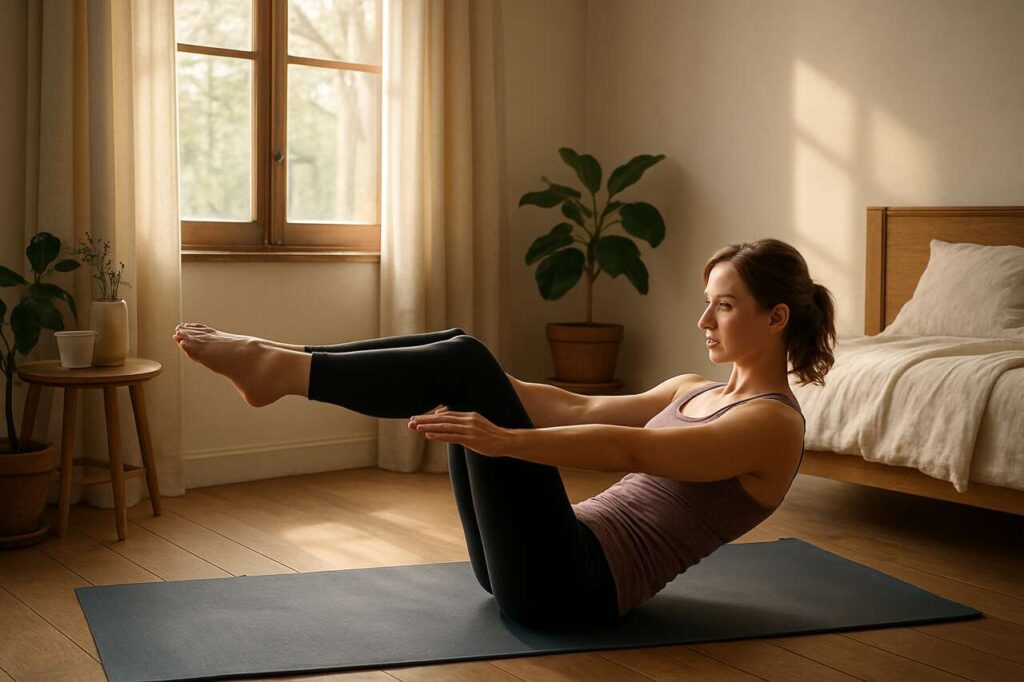
Most people think building core strength requires endless planks or expensive gym equipment, but science suggests otherwise. An 8-minute morning routine can deliver superior results by engaging multiple muscle groups through dynamic movements rather than static holds. This approach not only strengthens the abdominal muscles but also improves balance, posture, and overall functional fitness. The key lies in combining targeted exercises that activate the entire core system while requiring nothing more than your body weight and a small space in your home.
Quick routine: a new approach to strengthening the core
Understanding dynamic core training
Traditional core workouts often emphasize static holds like planks, which certainly have their place in fitness routines. However, dynamic movements that involve rotation, flexion, and extension can recruit more muscle fibers and improve functional strength more effectively. This 8-minute routine focuses on continuous movement patterns that challenge the core from multiple angles, creating a more comprehensive workout in less time.
The routine consists of six exercises performed for approximately 60 seconds each, with minimal rest between movements. This structure keeps your heart rate elevated while systematically targeting different areas of the core, including:
- Rectus abdominis (front abdominal wall)
- Obliques (side muscles)
- Transverse abdominis (deep stabilizing muscles)
- Erector spinae (lower back muscles)
- Hip flexors and glutes (supporting muscles)
Why eight minutes makes a difference
Research shows that high-intensity interval training can produce significant results in short durations. Eight minutes provides enough time to properly warm up, execute each exercise with proper form, and create metabolic stress that stimulates muscle adaptation. The brevity of the routine also eliminates the most common excuse for skipping workouts: lack of time. When performed consistently, this compact session delivers measurable improvements in core stability and strength within weeks.
Understanding the foundational benefits of core strength helps explain why this routine proves so effective for overall health and wellness.
The benefits of core strength for health
Beyond aesthetics: functional advantages
A strong core serves as the foundation for virtually every movement your body performs throughout the day. Whether you’re lifting groceries, playing with children, or sitting at a desk, your core muscles work constantly to stabilize your spine and pelvis. Developing these muscles reduces strain on other body parts and creates a more efficient movement system.
| Health Benefit | Impact on Daily Life |
|---|---|
| Improved posture | Reduced neck and shoulder tension |
| Lower back pain prevention | Decreased injury risk during activities |
| Better balance | Fall prevention, especially important with age |
| Enhanced athletic performance | Increased power transfer in sports |
Long-term health implications
Studies indicate that core strength correlates with longevity and quality of life as we age. People with stronger core muscles experience fewer mobility limitations and maintain independence longer. The core acts as a protective mechanism for the spine, reducing degenerative conditions and chronic pain that often accompany aging. Additionally, core training improves proprioception—your body’s awareness of its position in space—which becomes increasingly important for preventing falls and maintaining coordination.
Before diving into the exercises themselves, proper preparation ensures you maximize benefits while minimizing injury risk.
Warm-up: prepare the body for exercise
Essential movements to start safely
Spending just 90 seconds on a targeted warm-up prepares your muscles, joints, and nervous system for the work ahead. Begin with gentle movements that increase blood flow and activate the muscles you’ll be using. This preparation phase reduces injury risk and improves exercise performance by ensuring your body is ready for more demanding movements.
Start with these simple warm-up movements:
- Cat-cow stretches: 30 seconds of alternating spinal flexion and extension
- Torso rotations: 30 seconds of gentle twisting from side to side
- Hip circles: 30 seconds of circular hip movements in both directions
Breathing and mental preparation
Proper breathing patterns are crucial for core engagement. During your warm-up, practice diaphragmatic breathing by inhaling deeply through your nose, allowing your belly to expand, then exhaling fully through your mouth. This breathing technique activates the transverse abdominis and prepares your body for the controlled breathing you’ll use during exercises. Take a moment to mentally focus on the workout ahead, setting an intention to move with control and awareness rather than rushing through repetitions.
With your body properly warmed up, you’re ready to tackle the core-strengthening exercises that form the heart of this routine.
Simple exercises for a strong core without equipment
Dead bug variations
The dead bug exercise targets deep core stabilizers while teaching proper spinal alignment. Lie on your back with arms extended toward the ceiling and knees bent at 90 degrees. Slowly lower your right arm overhead while extending your left leg, keeping your lower back pressed to the floor. Return to starting position and repeat on the opposite side. Perform this movement for 60 seconds, focusing on controlled motion and steady breathing. This exercise builds anti-extension strength, which protects your spine during daily activities.
Bird dog holds and reaches
From a hands-and-knees position, extend your right arm forward and left leg backward simultaneously, creating a straight line from fingertips to toes. Hold for three seconds, then return to start and switch sides. Continue alternating for 60 seconds. This exercise develops cross-body coordination and challenges your balance while strengthening the entire posterior chain. Keep your hips level and avoid rotating your torso to maximize core engagement.
Mountain climbers with control
Begin in a push-up position with your body forming a straight line. Bring your right knee toward your chest, then return it to starting position before bringing the left knee forward. Unlike high-speed mountain climbers, perform these with deliberate control for 60 seconds. This variation emphasizes core stability while adding a cardiovascular component that elevates your heart rate and burns additional calories.
Side plank pulses
Lie on your side with your elbow directly beneath your shoulder and feet stacked. Lift your hips to create a straight line from head to feet. Instead of holding static, lower your hip toward the floor and lift back up repeatedly for 30 seconds per side. These dynamic pulses engage the obliques more effectively than traditional side planks while building endurance in the stabilizing muscles.
Bicycle crunches with extension
Lying on your back with hands behind your head, bring your right elbow toward your left knee while extending your right leg. Alternate sides in a pedaling motion for 60 seconds. Focus on rotating through your torso rather than pulling on your neck. This exercise targets the obliques and rectus abdominis while improving rotational strength that translates to everyday movements like reaching and twisting.
Hollow body rocks
Lie on your back and lift your shoulders and legs slightly off the ground, creating a “hollow” position with your lower back pressed to the floor. With arms extended overhead, gently rock back and forth for 60 seconds. This advanced movement builds incredible core tension and teaches full-body coordination. If the full version proves too challenging initially, keep your knees bent or arms at your sides.
Once you’ve mastered these exercises individually, the next step involves weaving them seamlessly into your morning schedule.
Incorporating these exercises into your daily routine
Finding the optimal time
Morning workouts offer distinct advantages for consistency and adherence. Exercising immediately after waking, before other obligations arise, ensures you complete your routine before distractions interfere. Many people find that morning exercise energizes them for the day ahead and improves mental clarity. However, the “best” time is ultimately the time you’ll actually do it consistently. If evenings work better for your schedule, adapt accordingly.
Consider these strategies for building the habit:
- Place your workout clothes next to your bed the night before
- Set a specific alarm dedicated to your exercise time
- Complete the routine before checking your phone or email
- Start with just three days per week and gradually increase frequency
- Link the habit to an existing routine, like immediately after brushing your teeth
Progression and variation
As your strength improves over weeks, you’ll need to increase the challenge to continue making progress. Rather than extending the routine beyond eight minutes, focus on improving form, increasing repetitions, or adding small progressions to each exercise. For example, hold the extended position in dead bugs longer, or perform mountain climbers from a decline position. These subtle adjustments keep the routine fresh while maintaining the time-efficient format.
Tracking your improvements and staying motivated ensures you maintain consistency long enough to see real results.
How to measure progress and maintain motivation
Objective metrics for core strength
Unlike weight loss or muscle gain, core strength improvements can be subtle and difficult to quantify visually. However, several practical measures indicate your progress. Track how long you can hold proper form during exercises, noting when movements that once felt challenging become manageable. Pay attention to reduced lower back discomfort during daily activities and improved posture throughout the day. These functional improvements often manifest before visible changes appear.
| Week | Benchmark Test | Goal |
|---|---|---|
| Week 1 | Maximum dead bug repetitions with perfect form | Establish baseline |
| Week 4 | Same test repeated | 25% improvement |
| Week 8 | Same test repeated | 50% improvement from baseline |
Staying committed to the practice
Motivation naturally fluctuates, which is why building systems matters more than relying on willpower alone. Create accountability by sharing your commitment with a friend or family member, or join an online community focused on bodyweight fitness. Take brief notes after each session about how you felt and any improvements you noticed. On difficult days when motivation wanes, remind yourself that eight minutes represents less than 1% of your waking hours—a minimal investment for significant returns.
Consider rewarding consistency milestones rather than outcome-based goals. Celebrate completing 30 consecutive days or never missing more than two days in a row. These behavior-focused rewards reinforce the habit itself rather than tying success to physical changes that may take longer to materialize. Remember that building core strength is a gradual process that compounds over time, with benefits extending far beyond the mirror.
This 8-minute morning routine offers a practical, equipment-free approach to building core strength that surpasses traditional plank-based workouts. By incorporating dynamic movements that engage multiple muscle groups, you develop functional strength that improves posture, reduces pain, and enhances overall quality of life. The key to success lies in consistency rather than intensity—showing up each morning and completing the routine with proper form matters more than perfect execution. As you progress, you’ll notice improvements not just in your core strength but in how you move through daily activities with greater ease and confidence. The minimal time investment and zero equipment requirement remove common barriers, making this routine accessible regardless of your schedule or fitness level.