

As the global population ages, maintaining physical independence has become a critical health priority. For older adults, simple tasks like standing up from a chair or walking across a room can present unexpected challenges. Balance issues, joint pain, and reduced mobility often conspire to undermine confidence and increase the risk of falls. Yet, a growing number of yoga instructors are finding that a straightforward three-move standing sequence can make a remarkable difference in how seniors navigate their daily lives. These poses require no special equipment, can be practiced in any living space, and offer both physical and psychological benefits that extend far beyond the yoga mat.
Importance of good posture in seniors
The connection between posture and overall health
Good posture serves as the foundation for nearly every physical activity older adults undertake. When the spine maintains its natural alignment, the body distributes weight more efficiently, reducing strain on joints and muscles. Poor posture, conversely, creates a cascade of problems that extend throughout the body. Rounded shoulders and a forward-leaning head position place excessive pressure on the neck and upper back, often leading to chronic pain. This misalignment also compresses internal organs, potentially affecting breathing capacity and digestive function.
For seniors, the stakes are particularly high. Postural deterioration often correlates with decreased balance, as the body’s center of gravity shifts forward. This makes falls more likely and recovery more difficult. Research consistently shows that individuals with better posture experience fewer mobility limitations and maintain independence longer than those who develop significant postural issues.
Age-related factors affecting posture
Several physiological changes contribute to postural decline as people age:
- Decreased bone density, particularly in the spine, can lead to compression fractures and a stooped appearance
- Loss of muscle mass and strength makes it harder to maintain proper alignment throughout the day
- Reduced flexibility in the hip flexors and hamstrings pulls the pelvis out of neutral position
- Previous injuries or surgical interventions may create compensatory movement patterns that become habitual
- Decreased proprioception makes it harder to sense body position in space
Understanding these factors helps explain why targeted interventions like yoga can be so effective. By addressing multiple components simultaneously, standing yoga sequences offer a comprehensive approach to postural improvement that medications or passive treatments cannot match.
Beyond the physical mechanics, posture also carries psychological significance. Older adults who maintain upright posture often report feeling more confident and engaged with their surroundings, setting the stage for exploring how yoga specifically enhances balance.
The benefits of yoga on balance
How yoga addresses balance challenges
Yoga’s effectiveness for balance improvement stems from its multifaceted approach. Unlike exercises that target isolated muscle groups, yoga integrates strength, flexibility, and body awareness into each movement. Standing poses particularly challenge the proprioceptive system, which relies on sensory feedback from joints and muscles to maintain stability. When older adults practice balancing poses regularly, they essentially retrain their nervous system to respond more quickly and accurately to shifts in position.
The practice also strengthens key muscle groups essential for stability. The feet, ankles, hips, and core all play crucial roles in maintaining balance, and standing yoga sequences activate these areas simultaneously. This functional training translates directly to real-world activities, making it easier to navigate uneven surfaces or recover from unexpected stumbles.
Physical and mental benefits for seniors
| Physical Benefits | Mental Benefits |
|---|---|
| Increased leg and core strength | Enhanced focus and concentration |
| Improved joint flexibility | Reduced anxiety about falling |
| Better coordination | Greater body confidence |
| Enhanced proprioception | Improved mindfulness |
| Reduced fall risk | Sense of accomplishment |
Yoga teachers working with older populations consistently observe that the mental transformation often precedes the physical improvements. Students who initially approach the mat with trepidation gradually develop confidence as they discover their bodies’ capabilities. This psychological shift proves just as valuable as the measurable gains in strength and balance, as it encourages continued practice and engagement with physical activity.
The breathing techniques integrated into yoga practice also contribute to stability. Controlled breathing helps calm the nervous system, reducing the tension that can interfere with smooth, coordinated movement. With these foundational benefits established, examining the specific poses reveals how they work in practice.
Tadasana: the mountain pose
Foundation and alignment principles
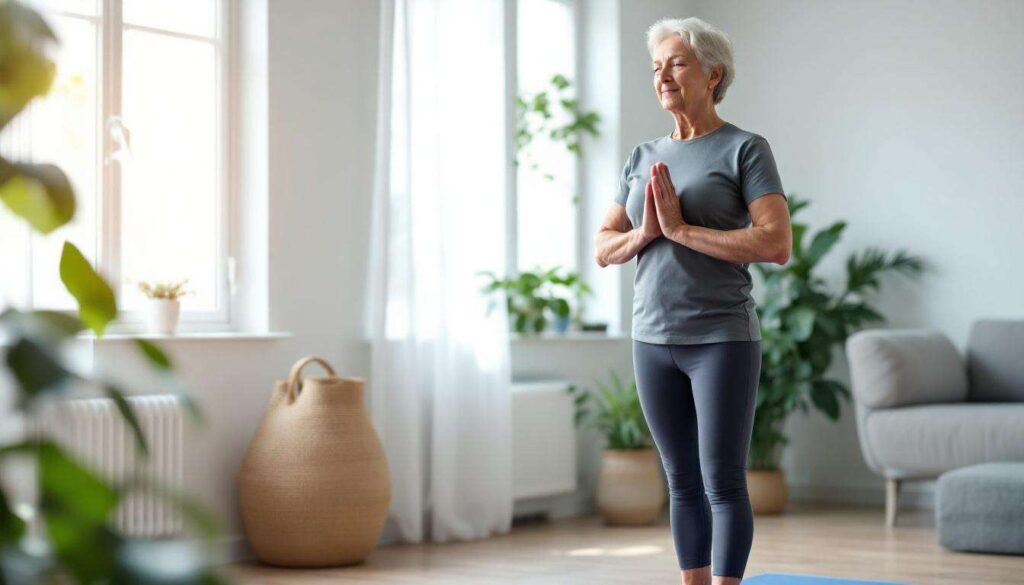
Tadasana, commonly known as mountain pose, appears deceptively simple but serves as the architectural blueprint for all standing yoga postures. In this pose, practitioners stand with feet hip-width apart, weight distributed evenly across all four corners of each foot. The legs engage without locking the knees, while the pelvis finds neutral position with the tailbone pointing downward. The spine lengthens, shoulders relax away from the ears, and the crown of the head reaches toward the ceiling.
For older adults, this pose offers an opportunity to recalibrate their relationship with gravity. Many seniors have adapted to postural compensations over years or decades, and mountain pose provides a reference point for proper alignment. The practice of standing still while maintaining active engagement throughout the body builds the foundational strength necessary for more complex movements.
Modifications and progressions
Accessibility remains paramount when teaching Tadasana to seniors. Instructors recommend several modifications:
- Standing with feet wider apart for increased stability
- Practicing near a wall or sturdy chair for support
- Focusing on weight distribution by gently rocking forward and back, then side to side
- Using a mirror to provide visual feedback about alignment
- Starting with shorter holds and gradually increasing duration as strength improves
As practitioners become comfortable with basic mountain pose, they can explore subtle variations that deepen the challenge. Closing the eyes removes visual reference points, forcing greater reliance on proprioception. Rising onto the toes briefly engages the calves and tests balance more dynamically.
The mindful awareness cultivated in mountain pose carries forward into more demanding balance work, particularly the tree pose that follows.
Vrksasana: improving balance with the tree pose
Executing the tree pose safely
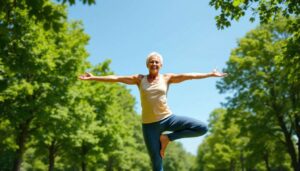
Tree pose introduces a single-leg balance challenge that directly addresses the stability concerns many seniors face. From mountain pose, the practitioner shifts weight onto one foot, then places the opposite foot against the standing leg. The key consideration for older adults involves choosing an appropriate foot placement. Rather than attempting the full expression with the foot high on the inner thigh, beginners can place the foot against the ankle or calf, keeping the toes on the ground for additional support.
The standing leg remains active, with the quadriceps engaged and the foot pressing firmly into the floor. The hips stay level, and the core muscles activate to prevent the torso from leaning. Arms can rest on the hips, extend to the sides, or press together at the chest, depending on what feels most stable. The gaze fixes on a stationary point at eye level, providing a visual anchor that aids balance.
Building confidence through progressive practice
Tree pose uniquely challenges both physical and mental stability. The wobbling that occurs, especially in early attempts, provides valuable feedback about which muscles need strengthening and how the body compensates for imbalance. Yoga instructors emphasize that falling out of the pose is part of the learning process, not a failure. Each attempt builds neural pathways that improve balance over time.
Seniors can track progress through several markers:
- Increased hold time on each leg
- Reduced need for external support
- Ability to place the foot higher on the standing leg
- Smoother transitions into and out of the pose
- Greater ease maintaining the position while breathing naturally
Many practitioners report that tree pose becomes a metaphor for life’s challenges, teaching them to find stability amid uncertainty. This mental resilience complements the physical benefits, preparing students for the final pose in the sequence.
Utkatasana: strengthening legs and stabilizing the core
The mechanics of chair pose
Utkatasana, or chair pose, concludes the three-move sequence with a powerful strengthening exercise that targets the legs, glutes, and core simultaneously. From mountain pose, practitioners bend their knees as if sitting back into an invisible chair, keeping the weight in the heels. The thighs work toward parallel with the floor, though seniors should only descend to a comfortable depth. The torso maintains length rather than collapsing forward, and the arms can extend overhead, forward, or rest on the thighs.
This pose demands significant muscular engagement. The quadriceps fire to support the bent-knee position, while the glutes and hamstrings work to stabilize the hips. The core muscles activate to prevent the lower back from arching excessively, creating a full-body integration that translates directly to functional movements like rising from a chair or climbing stairs.
Adaptations for different ability levels
| Modification | Benefit |
|---|---|
| Smaller knee bend | Reduces intensity while building strength |
| Hands on thighs | Provides additional support and reduces shoulder strain |
| Back against wall | Offers stability reference and prevents excessive forward lean |
| Shorter hold times | Allows gradual strength building without fatigue |
| Feet wider apart | Increases base of support for better balance |
The beauty of chair pose lies in its scalability. A senior recovering from surgery might hold the pose for just five seconds with minimal knee bend, while a more experienced practitioner might maintain a deeper position for thirty seconds or longer. Both receive benefits appropriate to their current capacity, and both can progress at their own pace without comparison or competition.
Regular practice of Utkatasana builds the leg strength essential for fall prevention and daily function. The pose also cultivates mental fortitude, as holding the position requires sustained focus and determination. These qualities extend beyond the mat into everyday life, where they support independence and confidence.
Tips for incorporating these poses into daily life
Creating sustainable practice habits
The true power of this three-pose sequence emerges through consistent practice integrated into daily routines. Rather than viewing yoga as a separate activity requiring special time and space, older adults can weave these movements into existing habits. Mountain pose can be practiced while waiting for coffee to brew or standing in line at the grocery store. Tree pose works well during tooth brushing, with the bathroom counter providing support if needed. Chair pose can be incorporated when retrieving items from low shelves or preparing to sit down.
Yoga instructors recommend starting with just one or two repetitions of each pose daily, focusing on quality over quantity. As the movements become familiar, practitioners naturally find more opportunities to practice. The key is removing barriers that might prevent engagement, such as the need for special clothing, equipment, or dedicated time blocks.
Safety considerations and progression
While these poses offer significant benefits, seniors should approach them thoughtfully:
- Consult with healthcare providers before beginning any new exercise program
- Always practice near stable support, especially when first learning the poses
- Never push through sharp pain or discomfort
- Focus on breathing naturally rather than holding the breath
- Progress gradually, celebrating small improvements rather than rushing toward advanced variations
- Consider working with a qualified yoga instructor experienced in teaching older adults
Documentation can enhance motivation and provide valuable feedback. Keeping a simple log of practice frequency and any observations about changes in balance or confidence helps practitioners recognize progress that might otherwise go unnoticed. Many seniors find that sharing their yoga journey with friends or family members creates accountability and encouragement.
The goal is not perfection but rather consistent engagement with movements that support long-term health and independence. Even brief daily practice accumulates significant benefits over weeks and months, building strength, balance, and confidence that enhance quality of life.
This accessible three-pose sequence demonstrates that effective balance training need not be complicated or time-consuming. By focusing on fundamental standing postures that strengthen the body while cultivating mindful awareness, older adults can address the physical and psychological challenges that often accompany aging. Mountain pose establishes proper alignment and body awareness, tree pose challenges single-leg stability, and chair pose builds the leg and core strength essential for daily activities. Together, these movements offer a practical pathway toward greater independence and confidence. The simplicity of the sequence makes it easy to practice anywhere, transforming routine moments into opportunities for physical and mental strengthening that support active, engaged living well into later years.