
Maintaining balance and stability becomes increasingly challenging as we age, yet these physical attributes remain crucial for independence and quality of life. A certified yoga instructor specializing in senior wellness has identified three fundamental standing poses that can make a significant difference in how older adults navigate their daily activities. These poses, rooted in ancient practice but validated by modern understanding of biomechanics, offer accessible pathways to improved stability without requiring expensive equipment or gym memberships.
Introduction to standing poses and stability
Standing poses form the foundation of physical stability in yoga practice, particularly for older practitioners seeking to maintain their balance and confidence in movement. Unlike seated or supine positions, standing poses require the body to engage multiple muscle groups simultaneously while maintaining equilibrium against gravity.
What makes standing poses effective
The effectiveness of standing poses lies in their ability to activate proprioceptive systems, which are the body’s internal sensors that communicate position and movement. When practicing these poses, older adults develop stronger connections between their nervous system and muscles, leading to improved reaction times and better balance control.
- Engagement of core stabilizing muscles
- Strengthening of ankle and foot muscles
- Enhancement of spatial awareness
- Improvement of postural alignment
- Development of mental focus and concentration
Research has demonstrated that regular practice of standing poses can reduce fall risk by up to forty-three percent in adults over sixty-five. This remarkable statistic highlights why yoga instructors increasingly recommend these specific postures for their senior students.
Understanding how aging affects our physical capabilities helps explain why these particular poses prove so beneficial for maintaining independence.
The effects of aging on balance
The aging process brings numerous changes to the body’s balance systems, affecting everything from muscle strength to sensory processing. These changes don’t happen overnight but accumulate gradually, often going unnoticed until a near-fall or actual incident occurs.
Physical changes that impact stability
As we age, several physiological changes conspire to make balance more challenging. Muscle mass naturally decreases at a rate of approximately three to eight percent per decade after age thirty, accelerating after sixty. This loss, known as sarcopenia, particularly affects the lower body muscles essential for maintaining upright posture.
| Age range | Average muscle loss per decade | Balance test score decline |
|---|---|---|
| 30-50 years | 3-5% | Minimal |
| 50-70 years | 5-8% | Moderate |
| 70+ years | 8-15% | Significant |
Sensory system deterioration
Beyond muscle loss, the vestibular system in the inner ear becomes less responsive, and vision changes reduce depth perception. Nerve conduction slows, meaning the brain receives and processes balance information less quickly. These combined factors create a perfect storm for instability.
The good news is that targeted practice can counteract many of these age-related changes, which is where specific yoga poses become invaluable.
The importance of standing poses in yoga
Standing poses occupy a special place in yoga practice because they mirror real-life movements while providing controlled environments for improvement. Unlike exercises performed on machines or in unusual positions, standing poses replicate the exact challenges older adults face when walking, reaching, or changing direction.
Functional fitness benefits
The concept of functional fitness emphasizes exercises that prepare the body for daily activities. Standing yoga poses excel in this area because they require practitioners to:
- Maintain balance while shifting weight
- Coordinate multiple body parts simultaneously
- Control movements through full ranges of motion
- Build endurance in weight-bearing positions
- Develop confidence in their physical capabilities
Mental and emotional components
Beyond physical benefits, standing poses cultivate mental resilience and body awareness. Older adults who practice these poses report feeling more confident navigating uneven surfaces, crowded spaces, or unexpected obstacles. This psychological component proves just as important as the physical strengthening.
With this understanding of why standing poses matter, we can examine the first of three essential positions recommended by experienced yoga teachers.
Tadasana: the mountain pose
Though it appears deceptively simple, tadasana or mountain pose serves as the blueprint for all other standing postures. This foundational pose teaches proper alignment and weight distribution, skills that directly translate to better balance in everyday activities.
How to practice mountain pose
To perform tadasana correctly, stand with feet hip-width apart, distributing weight evenly across all four corners of each foot. Engage the thigh muscles gently, lengthen the spine, and allow the arms to hang naturally at the sides. The head should balance directly over the shoulders, with the gaze forward and soft.
Key benefits for stability
Mountain pose strengthens the intrinsic foot muscles that act as the body’s first line of defense against imbalance. By practicing weight distribution awareness, older adults learn to make subtle adjustments that prevent falls before they begin.
- Improves posture and spinal alignment
- Strengthens ankles and arches
- Develops awareness of body positioning
- Builds foundational strength for other poses
- Enhances breathing patterns
Building upon the stable foundation established in mountain pose, the next position introduces a more dynamic balance challenge.
Vrksasana: the tree pose
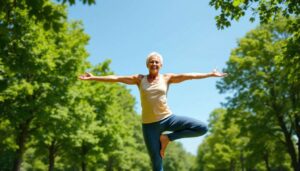
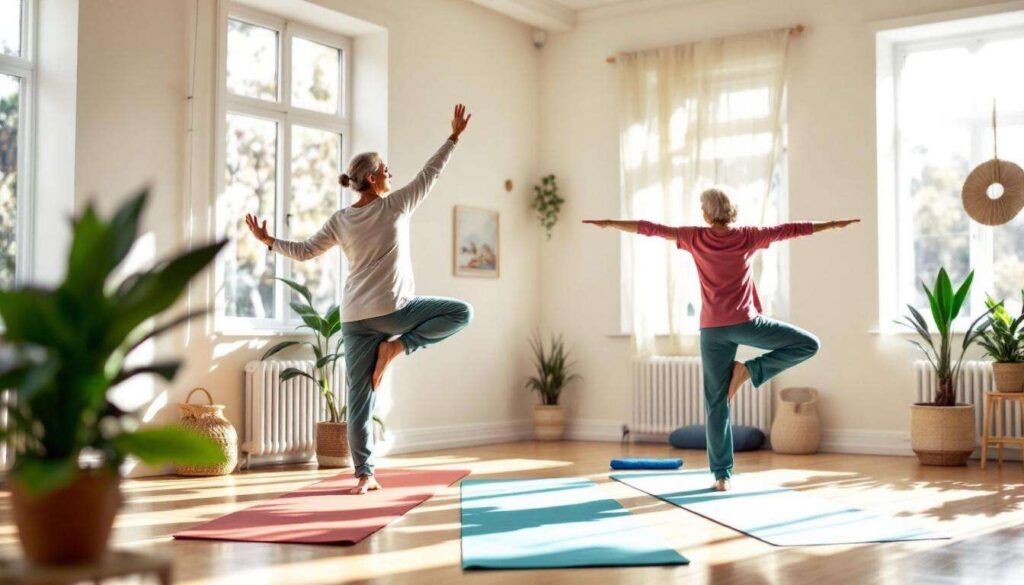
Tree pose represents a significant progression in balance training, requiring practitioners to maintain stability while standing on one leg. This asymmetrical position directly addresses the type of balance needed when walking, climbing stairs, or stepping over obstacles.
Executing tree pose safely
Begin in mountain pose, then shift weight onto one foot. Place the opposite foot against the standing leg, either at the ankle, calf, or inner thigh, never directly on the knee joint. Hands can rest on hips, at heart center, or extend overhead depending on comfort level.
Adaptations for different ability levels
The beauty of vrksasana lies in its scalability. Beginners can keep the lifted toe touching the ground for support, while more advanced practitioners can close their eyes to increase difficulty.
| Modification level | Foot position | Support used |
|---|---|---|
| Beginner | Toe on floor | Wall or chair |
| Intermediate | Foot at calf | Fingertips on wall |
| Advanced | Foot at thigh | No support |
While tree pose challenges balance, the final recommended pose adds an element of strength that further enhances stability.
Utkatasana: the chair pose
Chair pose, or utkatasana, combines strength building with balance maintenance, making it particularly valuable for older adults. This pose mimics the action of sitting down and standing up, one of the most important functional movements for maintaining independence.
Proper form and technique
From mountain pose, bend the knees as if sitting back into an invisible chair, keeping the weight in the heels. The thighs should aim toward parallel with the floor, though depth can be adjusted based on individual capability. Arms extend forward or overhead, and the spine remains long.
Why chair pose matters for seniors
The quadriceps and gluteal muscles strengthened in chair pose are the same muscles that prevent falls and enable safe navigation of stairs and uneven terrain. Additionally, this pose builds stamina, allowing older adults to maintain good form during longer periods of standing.
- Strengthens major leg muscle groups
- Improves hip and ankle flexibility
- Builds core stabilization
- Enhances ability to rise from seated positions
- Increases overall lower body endurance
Practicing these three poses effectively requires attention to safety considerations and appropriate modifications for individual needs.
Safety tips and modifications for seniors
While these three poses offer tremendous benefits, safety must always come first when older adults begin or continue their yoga practice. Proper precautions and intelligent modifications ensure that the practice remains beneficial rather than risky.
Essential safety guidelines
Before beginning any new exercise program, older adults should consult with healthcare providers, especially those with existing balance issues, osteoporosis, or cardiovascular conditions. During practice, keeping a sturdy chair or wall within reach provides security without diminishing the pose’s effectiveness.
- Always practice on non-slip surfaces
- Wear appropriate footwear or practice barefoot
- Never push into pain or discomfort
- Start with shorter hold times and gradually increase
- Practice when feeling alert and energized
- Consider working with a certified yoga instructor experienced in senior fitness
Adapting poses for individual needs
Each person’s body presents unique challenges and capabilities. Some older adults may need to practice all three poses with wall support initially, while others might find certain poses easier than expected. The key is progressive adaptation, gradually reducing support as strength and confidence grow.
| Common challenge | Recommended modification |
|---|---|
| Limited ankle mobility | Reduce depth in chair pose |
| Hip flexibility issues | Lower foot placement in tree pose |
| General instability | Practice all poses near wall support |
| Fatigue | Shorter hold times with more repetitions |
These three standing poses offer older adults a practical, accessible method for dramatically improving stability and balance. Mountain pose establishes proper alignment and body awareness, tree pose challenges single-leg balance in a controlled manner, and chair pose builds the strength necessary for functional movements. Together, they address the multiple factors that contribute to fall risk while promoting confidence and independence. With appropriate modifications and attention to safety, these poses can be practiced by adults of varying fitness levels, making them ideal components of a comprehensive approach to healthy aging. Regular practice, even just a few minutes daily, can yield significant improvements in stability, ultimately supporting a more active and independent lifestyle well into the later years.