



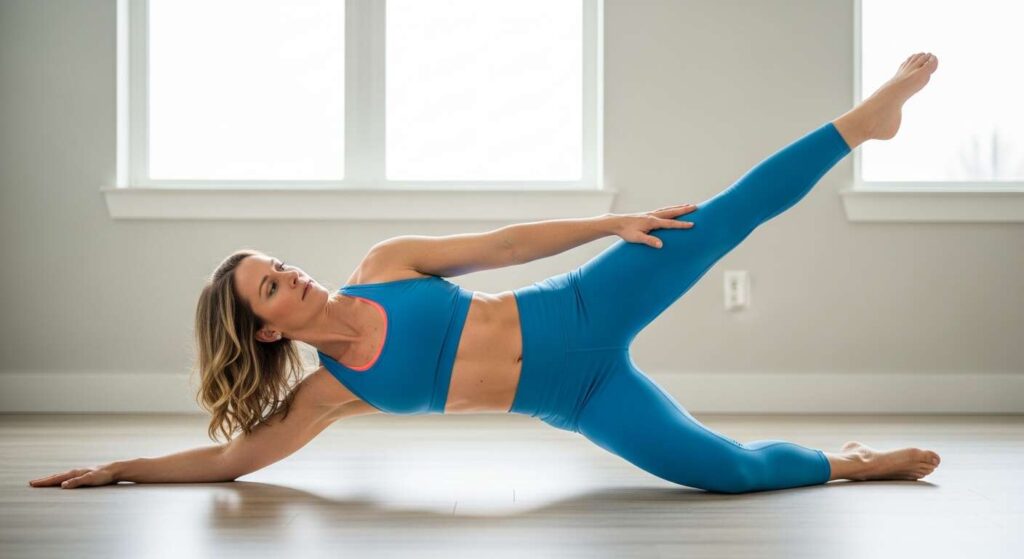
Hip strength remains one of the most underestimated components of overall physical fitness, yet it plays a crucial role in maintaining balance, posture, and functional movement throughout daily activities. A seasoned Pilates instructor recently brought attention to a specific side-lying exercise that targets the hip muscles with remarkable precision and effectiveness. This simple yet powerful movement has the potential to transform not only your Pilates practice but also your performance in various physical activities ranging from walking to competitive sports.
Introduction to the role of hip strengthening in Pilates
The foundation of core stability
Pilates methodology has always emphasized the importance of core strength as the foundation for all movement. However, the core extends beyond the abdominal muscles to include the hips, which serve as a critical junction between the upper and lower body. When hip muscles function optimally, they provide essential support for the spine and pelvis, allowing for more efficient movement patterns and reduced risk of injury.
The hip complex consists of multiple muscle groups that work in coordination to stabilize, rotate, and move the legs in various directions. These muscles include:
- Hip abductors that move the leg away from the body’s midline
- Hip adductors that bring the leg toward the center
- Hip flexors that lift the leg forward
- Hip extensors that move the leg backward
- Hip rotators that turn the leg inward and outward
Connecting hip health to whole-body function
Research in biomechanics has consistently demonstrated that weak hip muscles can lead to compensatory movement patterns throughout the body. When the hips lack adequate strength, other areas must work harder to maintain balance and stability, often resulting in strain on the knees, lower back, and ankles. This cascade effect underscores why Pilates instructors place such emphasis on developing hip strength as part of a comprehensive fitness approach.
Understanding this connection between hip function and overall body mechanics sets the stage for exploring specific exercises that target these vital muscle groups.
The importance of the side-lying movement in Pilates
Why the side-lying position matters
The side-lying position offers unique advantages for isolating and strengthening the hip muscles. Unlike standing exercises where gravity pulls vertically, the lateral position creates a different gravitational challenge that specifically targets the hip abductors. This positioning allows practitioners to focus on precise muscle activation without the distraction of maintaining full-body balance against vertical forces.
When performed correctly, side-lying exercises eliminate compensatory movements that often occur in upright positions. The body’s contact with the floor provides feedback and support, making it easier to maintain proper alignment while concentrating on the targeted muscle groups.
The side-lying leg lift as a cornerstone exercise
Among the various side-lying exercises in Pilates, the leg lift stands out for its effectiveness in building hip strength and control. This movement specifically engages the hip abductor muscles, which are responsible for moving the leg away from the body’s centerline and stabilizing the pelvis during single-leg activities like walking and running.
| Muscle Group | Primary Function | Daily Activity Benefit |
|---|---|---|
| Hip Abductors | Lateral leg movement | Walking stability |
| Core Stabilizers | Trunk control | Posture maintenance |
| Thigh Muscles | Leg support | Movement efficiency |
The beauty of this exercise lies in its ability to teach the legs to function optimally from the core, creating a strong foundation for all movement patterns. This fundamental principle becomes even more apparent when examining the precise technique required to perform the movement correctly.
Detailed technique to perform the move correctly
Setting up the starting position
Proper setup is crucial for maximizing the effectiveness of the side-lying leg lift. Begin by lying on your side on a comfortable mat or firm surface. Prop yourself up on your elbow, creating a straight line from your elbow through your ribs to your hips. This alignment ensures that your spine maintains its natural curves while providing adequate support.
Your legs should be positioned at an obtuse angle, approximately halfway between completely straight and a 45-degree bend. This specific angle allows for optimal muscle engagement while maintaining joint safety. Place your top hand in front of your chest for additional support and stability throughout the movement.
Achieving proper body alignment
Alignment serves as the cornerstone of effective Pilates practice. Before initiating any movement, verify that your body maintains these key alignment points:
- Shoulders stacked directly over one another
- Hips aligned vertically without rolling forward or backward
- Ankles positioned in line with hips and shoulders
- Bottom foot and ankle flat and stable on the ground
- Neck elongated and head in neutral position
Executing the movement sequence
Once proper alignment is established, the movement itself follows a specific sequence. Lift your top leg to hip height, maintaining the alignment of your body without allowing your torso to shift or rotate. The leg should move smoothly and with control, powered by the hip muscles rather than momentum.
After reaching hip height, kick the leg forward in a controlled manner. This forward kick adds an additional challenge to the hip stabilizers and engages the core muscles more deeply. Throughout the entire movement, focus on maintaining the initial body alignment and breathing steadily.
Mastering this technique opens the door to experiencing the full range of benefits this exercise offers for hip strength and overall body control.
The benefits of the move for hip strength and control
Targeted muscle development
The side-lying leg lift provides focused strengthening of the hip abductor muscles, particularly the gluteus medius and gluteus minimus. These muscles play a vital role in stabilizing the pelvis during single-leg activities and preventing the hip from dropping on the unsupported side. Stronger hip abductors translate directly to improved balance and reduced risk of falls.
Beyond the primary hip muscles, this exercise engages the entire lateral chain of muscles along the side of the body. The oblique abdominals work to maintain torso stability, while the thigh muscles assist in controlling the leg movement. This integrated muscle activation creates functional strength that transfers readily to real-world activities.
Functional improvements in daily activities
The strength and control gained from regular practice of this exercise extend far beyond the Pilates studio. Practitioners often notice improvements in various aspects of their daily lives and athletic pursuits:
- Enhanced standing posture with reduced hip sway
- More efficient walking gait with better hip control
- Improved running mechanics and reduced injury risk
- Better cycling power and stability on the bike
- Stronger swimming strokes with improved body rotation
Preventing postural imbalances
Health experts consistently emphasize the connection between hip health and overall body alignment. Weak hip muscles can lead to alterations in pelvic positioning, which in turn affects spinal alignment and posture. By strengthening the hips through exercises like the side-lying leg lift, practitioners can prevent or correct these postural imbalances before they lead to chronic pain or dysfunction.
The exercise also promotes bilateral balance, ensuring that both sides of the body develop equal strength and control. This symmetry is essential for maintaining proper body mechanics and preventing compensatory patterns that can lead to overuse injuries.
Understanding these benefits naturally leads to the question of how to effectively incorporate this powerful movement into a regular fitness routine.
Incorporating the move into a daily routine
Recommended practice frequency
For optimal results, experts suggest practicing the side-lying leg lift several times per week. This frequency allows for adequate muscle stimulation while providing sufficient recovery time between sessions. Beginners might start with two to three sessions per week, gradually increasing as strength and endurance improve.
Each practice session need not be lengthy. A focused ten to fifteen-minute session can deliver significant benefits when performed with proper technique and attention to form. The key lies in consistency and quality rather than duration.
Integration with existing workout programs
The side-lying leg lift fits seamlessly into various types of workout routines. Consider these integration strategies:
- Add it as a warm-up before cardio activities to activate hip stabilizers
- Include it in a dedicated Pilates or core strengthening session
- Use it as a cool-down exercise after running or cycling
- Incorporate it into a full-body strength training circuit
- Practice it as a standalone exercise during active recovery days
Progressive challenge and variation
As strength develops, the exercise can be modified to provide continued challenge. Increasing repetitions represents the most straightforward progression, moving from sets of eight to ten repetitions up to fifteen or twenty as endurance improves. Adding resistance through ankle weights or resistance bands provides another level of challenge for advanced practitioners.
The movement can also be performed more slowly to increase time under tension, or with brief holds at the top position to enhance muscle endurance. These variations ensure that the exercise continues to deliver benefits even as fitness levels advance.
However, progression should always be balanced with proper technique, which requires awareness of common mistakes that can diminish the exercise’s effectiveness.
Tips to avoid common mistakes and optimize results
Maintaining proper alignment throughout
The most frequent error in performing the side-lying leg lift involves losing body alignment during the movement. Many practitioners allow their torso to roll backward or their hips to shift out of position as they lift the leg. This compensation reduces the exercise’s effectiveness and can strain other areas of the body.
To prevent this, focus on keeping the body in one plane throughout the movement. Imagine pressing your back against an invisible wall, maintaining contact from shoulders to hips. Engaging the core muscles before initiating the leg lift helps stabilize the torso and prevent unwanted movement.
Controlling movement speed and momentum
Another common mistake involves using momentum rather than muscle control to lift the leg. Rapid, jerky movements reduce muscle engagement and increase injury risk. Instead, move the leg with deliberate control, taking two to three seconds to lift and the same amount of time to lower.
Key points for maintaining control include:
- Breathing steadily throughout the movement
- Avoiding any bouncing or swinging motions
- Keeping the leg at hip height rather than lifting higher
- Maintaining consistent tension in the working muscles
- Moving through the full range of motion without rushing
Addressing individual limitations
Not everyone will be able to perform the exercise with perfect form immediately. Individual variations in flexibility, strength, and body structure may require modifications. Those with limited shoulder mobility might need to lower the propped elbow slightly or use additional cushioning for support.
If maintaining the leg position proves challenging, start with smaller movements and gradually increase range of motion as strength develops. The focus should always remain on quality over quantity, ensuring that each repetition is performed with proper form rather than completing a specific number of repetitions with compromised technique.
Regular practice with attention to these technical details will yield the best results, transforming hip strength and control over time.
The side-lying leg lift represents a powerful tool for developing hip strength and control that extends far beyond the Pilates mat. This accessible exercise requires no equipment and only a few minutes of regular practice to deliver meaningful improvements in balance, posture, and functional movement. By targeting the hip abductors and engaging the core stabilizers, it addresses a critical component of overall physical fitness that often receives insufficient attention. Whether you are an experienced athlete seeking performance gains or someone simply looking to move through daily activities with greater ease and confidence, incorporating this movement into your routine several times per week can produce notable benefits. The key lies in maintaining proper alignment, moving with control, and practicing consistently while avoiding common technical errors. With patience and attention to form, this simple yet effective exercise can dramatically enhance hip strength and improve the way your body functions in all activities.