

Maintaining leg strength becomes increasingly crucial as we age, yet traditional exercises like squats can place excessive strain on aging joints and muscles. For individuals over 60, finding effective alternatives that rebuild strength without risking injury presents a significant challenge. Physiotherapists have identified chair-based exercises as a safer, more accessible solution that delivers remarkable results. These seated movements target the same muscle groups as squats while providing stability and reducing the risk of falls or joint damage. The beauty of chair exercises lies in their adaptability and the confidence they inspire in older adults who may feel unsteady on their feet.
The benefits of leg exercises after 60
Enhanced mobility and independence
Regular leg exercises after 60 provide foundational support for daily activities that many people take for granted. Strong legs enable individuals to climb stairs, walk longer distances, and maintain balance during routine tasks. Physical therapists consistently emphasize that muscular strength in the lower body directly correlates with independence levels in older adults.
| Benefit | Impact on Daily Life | Improvement Timeline |
|---|---|---|
| Balance improvement | Reduced fall risk by 40% | 4-6 weeks |
| Joint stability | Less pain during movement | 3-4 weeks |
| Muscle mass retention | Better metabolism and energy | 6-8 weeks |
Bone density and joint health preservation
Leg exercises contribute significantly to maintaining bone density, which naturally decreases with age. Weight-bearing movements stimulate bone formation and slow the progression of osteoporosis. The controlled resistance provided by chair exercises creates enough stress on bones to promote strengthening without overwhelming fragile structures. Additionally, these movements increase synovial fluid production, which lubricates joints and reduces arthritis symptoms.
Cardiovascular and metabolic advantages
Strengthening leg muscles offers surprising benefits beyond the musculoskeletal system. Larger muscle groups in the legs require substantial energy, which:
- Increases metabolic rate and supports healthy weight management
- Improves circulation throughout the lower extremities
- Enhances glucose metabolism and insulin sensitivity
- Reduces the risk of cardiovascular complications
Understanding these comprehensive benefits sets the stage for exploring why traditional squats may not be the optimal choice for this age group.
Why avoid squats after 60
Joint stress and injury risk
Traditional squats place significant compressive forces on the knees, hips, and lower back, areas where degenerative changes commonly occur after 60. The deep knee flexion required during squats can aggravate existing arthritis or accelerate cartilage wear. Physiotherapists note that the risk-to-benefit ratio shifts unfavorably as joint integrity declines, making squats potentially harmful rather than helpful for many older adults.
Balance and stability concerns
The unsupported nature of squats requires substantial balance control, which naturally diminishes with age. Performing squats without support increases fall risk, particularly when fatigue sets in during later repetitions. Many individuals over 60 also experience vestibular changes that affect spatial awareness, making the descent and ascent phases of squats particularly hazardous.
Blood pressure fluctuations
Squats can cause rapid blood pressure changes that pose risks for older adults. The Valsalva maneuver, often performed unconsciously during squats, involves holding breath while exerting force, which:
- Dramatically increases intrathoracic pressure
- Temporarily reduces blood flow to the heart and brain
- May trigger dizziness or fainting episodes
- Poses particular danger for those with cardiovascular conditions
These safety considerations make chair-based alternatives not just preferable but essential for effective strength training in this demographic.
Exercise 1: seated leg raises
Proper execution technique
Seated leg raises target the quadriceps and hip flexors with minimal joint stress. To perform this exercise correctly, sit upright in a sturdy chair with feet flat on the floor. Extend one leg straight out in front of you, keeping the knee locked and foot flexed. Hold this position for three to five seconds before lowering the leg slowly. The controlled movement pattern builds strength throughout the entire range of motion without requiring balance or creating joint compression.
Progression strategies and modifications
Begin with 10 repetitions per leg and gradually increase to 15-20 as strength improves. For added resistance:
- Attach ankle weights starting at one pound
- Increase hold time to 8-10 seconds
- Perform the movement more slowly, taking 4 seconds to raise and 4 seconds to lower
- Add a flex-and-point motion at the ankle during the hold
| Week | Repetitions | Sets | Resistance |
|---|---|---|---|
| 1-2 | 10 | 2 | Body weight |
| 3-4 | 12 | 2 | Body weight |
| 5-6 | 15 | 3 | 1 lb weight |
This foundational exercise prepares the muscles for more dynamic movements found in the next variation.
Exercise 2: alternating leg extension
Muscle groups targeted
Alternating leg extensions provide comprehensive quadriceps development while also engaging the core stabilizers. This exercise mimics functional movements like walking and climbing stairs more closely than static holds. The alternating pattern creates a rhythmic coordination challenge that enhances neuromuscular connections, improving overall movement quality.
Step-by-step instructions
Sit toward the front edge of a chair with back straight and hands gripping the sides for stability. Extend the right leg until nearly straight, pause briefly, then lower it while simultaneously extending the left leg. Continue this alternating pattern without allowing feet to rest completely on the floor between repetitions. Maintain steady breathing throughout, exhaling during extension and inhaling during the lowering phase.
Common mistakes to avoid
Many individuals compromise form in ways that reduce effectiveness or increase injury risk:
- Leaning backward or slouching, which disengages core muscles
- Moving too quickly, which relies on momentum rather than muscle strength
- Allowing the knee to bend excessively during extension
- Holding breath during exertion, which raises blood pressure
- Gripping the chair too tightly, creating unnecessary upper body tension
Mastering this dynamic movement creates a foundation for addressing often-neglected lower leg components.
Exercise 3: seated ankle rotations
Importance for balance and stability
Ankle mobility plays a crucial role in preventing falls and maintaining proper gait patterns. Seated ankle rotations improve proprioception, the body’s ability to sense position and movement in space. This awareness becomes increasingly important as sensory feedback systems decline with age. Enhanced ankle flexibility also reduces the risk of sprains during unexpected movements or uneven surfaces.
Detailed movement pattern
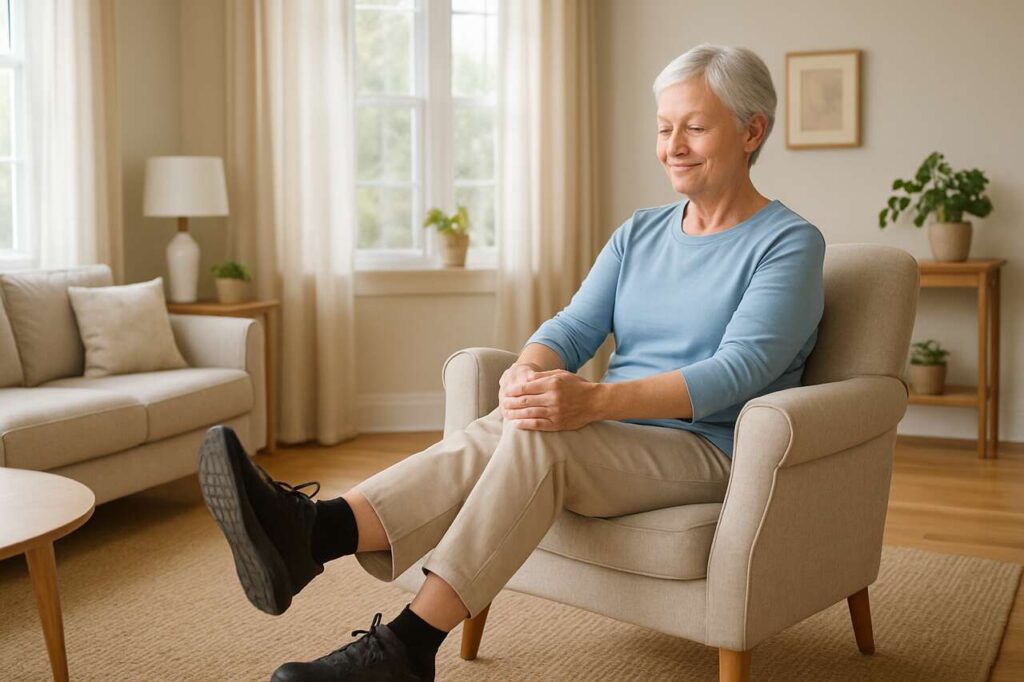
While seated with one foot slightly elevated off the floor, slowly rotate the ankle in a circular motion, drawing the largest circle possible with the toes. Complete 10 rotations in one direction, then reverse for 10 rotations in the opposite direction. The movement should originate from the ankle joint itself, not from rotating the entire leg. Focusing on smooth, continuous circles rather than speed maximizes therapeutic benefit.
Integration with other exercises
Ankle rotations serve as an excellent warm-up before performing leg raises or extensions. They can also function as an active recovery exercise between more demanding movements. Physical therapists recommend:
- Performing ankle rotations before standing from prolonged sitting
- Using them as a gentle cool-down after walking or other activities
- Incorporating them throughout the day during sedentary periods
- Combining them with calf stretches for comprehensive lower leg care
Building on this foundation of ankle mobility, the final exercise targets the often-weakened calf muscles.
Exercise 4: seated heel raises
Calf strengthening benefits
Seated heel raises specifically target the gastrocnemius and soleus muscles, which propel the body forward during walking and provide essential support during standing activities. Strong calves reduce the burden on knees and hips by absorbing impact forces. This exercise also promotes venous return from the lower legs, reducing swelling and improving circulation.
Execution technique for maximum effectiveness
Sit with feet flat on the floor, positioned hip-width apart. Press through the balls of the feet to lift both heels as high as possible, holding the raised position for two seconds before lowering slowly. The controlled descent phase provides as much benefit as the lifting phase, so resist the urge to drop heels quickly. Keep knees aligned over ankles throughout the movement to maintain proper biomechanics.
Progressive overload options
| Level | Method | Intensity Increase |
|---|---|---|
| Beginner | Body weight only | Baseline |
| Intermediate | Place weight on thighs | 5-10 lbs |
| Advanced | Single-leg raises | Double resistance per leg |
As strength develops, these progression strategies ensure continued improvement without requiring more complex equipment or movements. With all four exercises understood, the focus shifts to practical implementation strategies.
Tips for incorporating these exercises into your daily routine
Creating a sustainable schedule
Consistency matters more than intensity when rebuilding leg strength after 60. Physical therapists recommend performing these exercises three to four times weekly, allowing rest days for muscle recovery. Morning sessions often prove most successful, as energy levels tend to be higher and the routine becomes established before daily distractions arise. Each complete session requires only 15-20 minutes, making it manageable even for busy schedules.
Environmental setup for safety
Proper preparation reduces injury risk and increases exercise adherence:
- Choose a sturdy chair without wheels, preferably with armrests
- Position the chair on a non-slip surface or exercise mat
- Ensure adequate space around the chair for leg extension
- Keep a phone nearby in case assistance becomes necessary
- Maintain good lighting to monitor form and foot placement
Tracking progress and maintaining motivation
Documenting improvements provides tangible evidence of success and encourages continued effort. Keep a simple log noting repetitions, sets, and any modifications used. Many individuals notice functional improvements before visible muscle changes, such as climbing stairs with less effort or walking longer distances without fatigue. Celebrate these practical victories as they represent the true purpose of strength training at this stage of life.
When to seek professional guidance
While these exercises are generally safe, certain situations warrant consultation with a physical therapist or physician. Schedule an evaluation if you experience sharp pain during movements, notice increased swelling in joints, or develop persistent muscle soreness lasting beyond 48 hours. Professional guidance proves particularly valuable for individuals with existing conditions like severe osteoporosis, recent joint replacements, or cardiovascular concerns requiring exercise modifications.
Rebuilding leg strength after 60 requires neither dangerous movements nor complicated equipment. These four chair exercises deliver superior results compared to traditional squats by providing stability, reducing joint stress, and targeting multiple muscle groups effectively. Seated leg raises and alternating extensions strengthen the quadriceps and hip flexors, while ankle rotations improve balance and proprioception. Seated heel raises complete the program by developing often-neglected calf muscles essential for walking and circulation. Implementing these movements three to four times weekly creates noticeable improvements in mobility, independence, and overall quality of life within just a few weeks. The accessibility of chair-based training removes common barriers, making consistent strength development achievable for virtually anyone committed to maintaining their physical capabilities.