


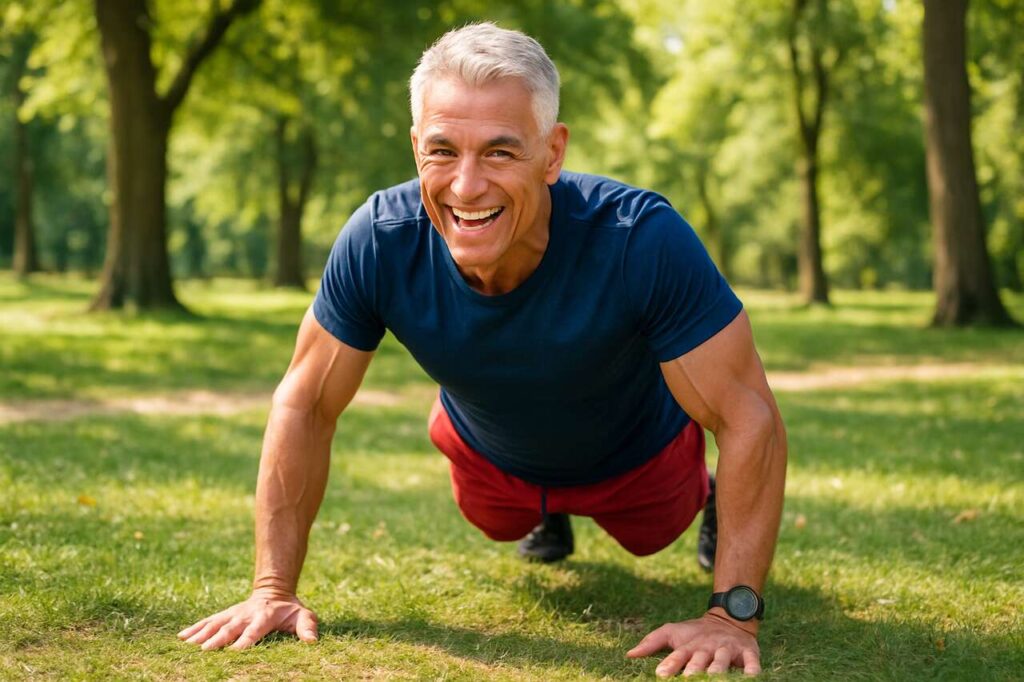
Reaching the milestone of 50 doesn’t mean your fitness journey should slow down. In fact, maintaining physical strength and endurance becomes even more critical as we age. The ability to perform certain bodyweight exercises without rest serves as an excellent benchmark for overall fitness and functional strength. These movements test multiple aspects of physical conditioning, including muscular endurance, cardiovascular capacity, core stability, and joint mobility. If you can complete all four exercises in sequence without stopping, you’re demonstrating elite-level fitness that puts you ahead of most people in your age group.
The benefits of bodyweight exercises after 50
Bodyweight training offers unique advantages for individuals over 50, making it an ideal fitness approach for this demographic. Unlike heavy weightlifting that can stress joints and connective tissues, bodyweight movements allow for natural range of motion while building functional strength applicable to daily activities.
Joint-friendly strength building
As we age, our joints become more susceptible to wear and tear. Bodyweight exercises provide resistance training benefits without the compressive forces associated with external weights. This approach helps preserve joint health while still challenging muscles effectively. The controlled movements allow you to work within comfortable ranges while gradually expanding mobility and strength.
Improved balance and coordination
Falls represent a significant health risk for people over 50. Bodyweight exercises inherently challenge your balance and proprioception, training your body to maintain stability in various positions. This translates directly to reduced fall risk and better coordination in everyday situations.
Cardiovascular and metabolic benefits
Performing bodyweight exercises with minimal rest elevates heart rate and creates a metabolic demand that supports:
- Enhanced cardiovascular endurance and heart health
- Improved insulin sensitivity and blood sugar regulation
- Increased metabolic rate for better weight management
- Better oxygen utilization throughout the body
Understanding these benefits sets the foundation for appreciating why these four specific exercises serve as such effective fitness markers.
Assessing your current fitness level
Before attempting the four-exercise challenge, it’s essential to establish a baseline understanding of your current capabilities. This assessment helps prevent injury and provides a realistic starting point for progression.
Self-evaluation guidelines
Begin by testing each exercise individually with proper rest between attempts. Record the number of repetitions you can perform with correct form before fatigue sets in. Quality always trumps quantity, and maintaining proper technique prevents injury while ensuring you’re actually building the right movement patterns.
Key performance indicators
| Fitness Level | Squats | Plank Duration | Push-ups | Burpees |
|---|---|---|---|---|
| Beginner | 5-10 | 20-30 seconds | 5-10 | 3-5 |
| Intermediate | 15-20 | 45-60 seconds | 15-20 | 8-12 |
| Advanced | 25-30 | 90+ seconds | 25-30 | 15-20 |
| Elite | 40+ | 120+ seconds | 40+ | 25+ |
These benchmarks provide context for where you stand and what constitutes elite performance. With this baseline established, let’s examine the first exercise in detail.
Exercise 1: the squat and its variations
The squat stands as one of the most fundamental human movement patterns, testing lower body strength, hip mobility, and overall functional fitness. For the elite challenge, aim to complete 30 consecutive squats with proper form.
Proper squat technique
Stand with feet shoulder-width apart, toes slightly pointed outward. Lower your body by bending at the hips and knees simultaneously, keeping your chest up and weight distributed through your entire foot. Descend until thighs are parallel to the ground or slightly below, then drive through your heels to return to standing. Your knees should track over your toes without collapsing inward, and your spine should maintain a neutral position throughout the movement.
Common modifications for beginners
- Box squats: sit back onto a bench or chair to control depth
- Supported squats: hold onto a sturdy object for balance assistance
- Partial squats: reduce range of motion until strength improves
- Wall squats: use a wall for back support while building leg strength
Progressive variations for advanced practitioners
Once standard squats become manageable, consider these challenging variations to continue building strength. Pistol squats performed on one leg dramatically increase difficulty. Jump squats add explosive power development. Pause squats with a three-second hold at the bottom position enhance time under tension and muscle recruitment.
Mastering the squat prepares your body for the core-intensive challenge that follows.
Exercise 2: the plank for optimal core strength
The plank serves as the ultimate test of core endurance and stability. For elite status, you should maintain a proper plank position for a minimum of 90 seconds without rest.
Perfect plank positioning
Begin in a forearm plank position with elbows directly beneath shoulders and forearms parallel to each other. Your body should form a straight line from head to heels, with core engaged and glutes contracted. Avoid letting your hips sag toward the floor or pike upward. Keep your neck neutral by looking at the floor slightly ahead of your hands, and breathe steadily throughout the hold.
Building plank endurance
If 90 seconds seems impossible, start with shorter intervals and gradually increase duration. Try holding for 20-30 seconds, resting briefly, then repeating for multiple sets. As your core strength improves, extend the hold time while reducing rest periods between attempts.
Plank variations to enhance difficulty
- Side planks to target obliques and lateral stability
- Plank with leg lifts to challenge balance and glute activation
- Plank shoulder taps to add dynamic movement and coordination
- Weighted planks with a plate on your back for increased resistance
A strong core foundation from planking directly supports the upper body demands of the next exercise.
Exercise 3: push-ups, the essential
Push-ups represent a comprehensive upper body strength test, engaging chest, shoulders, triceps, and core simultaneously. The elite benchmark requires 30 consecutive push-ups with strict form.
Correct push-up execution
Start in a high plank position with hands slightly wider than shoulder-width. Lower your body as a single unit by bending your elbows, keeping them at approximately 45 degrees from your torso. Descend until your chest nearly touches the floor, maintaining a straight line from head to heels. Press back up to the starting position, fully extending your arms without locking elbows. Your core should remain tight throughout, preventing any sagging or piking at the hips.
Regression options for building strength
| Modification | Difficulty Level | Primary Benefit |
|---|---|---|
| Wall push-ups | Easiest | Learning proper movement pattern |
| Incline push-ups | Easy | Reducing body weight percentage |
| Knee push-ups | Moderate | Building upper body strength |
| Negative push-ups | Challenging | Developing eccentric strength |
With upper body strength demonstrated, you’re ready for the final and most demanding movement.
Exercise 4: burpees, the ultimate challenge
Burpees combine strength, power, and cardiovascular endurance into one brutally effective movement. Completing 20 burpees without rest demonstrates elite-level conditioning that few people over 50 can achieve.
Standard burpee technique
Begin standing, then drop into a squat position and place hands on the floor. Jump or step feet back into a plank position, perform a push-up, then jump or step feet back to hands. Explosively jump upward, reaching arms overhead, then immediately begin the next repetition. Each phase should flow smoothly into the next, maintaining consistent rhythm and controlled breathing despite the cardiovascular demand.
Modified approaches for beginners
If full burpees prove too challenging initially, implement these modifications while building capacity:
- Step back instead of jumping into plank position
- Eliminate the push-up component temporarily
- Remove the jump at the top, simply standing instead
- Perform on an incline to reduce intensity
- Break the movement into separate components practiced individually
Why burpees define elite fitness
This exercise tests everything simultaneously: leg power, upper body strength, core stability, coordination, and cardiovascular capacity. The ability to perform 20 quality repetitions without rest indicates exceptional full-body conditioning and mental toughness. It demonstrates that your body can handle high-intensity demands and recover quickly between efforts.
Achieving this level requires smart training practices that prioritize longevity and injury prevention.
Tips for injury-free progression
Reaching elite fitness after 50 demands patience and intelligent programming. Pushing too hard too quickly leads to setbacks that derail progress.
Prioritize recovery and adaptation
Your body needs adequate time to adapt to training stress. Schedule at least one full rest day between intense bodyweight sessions, and listen to your body’s signals. Persistent joint pain or unusual fatigue indicates the need for additional recovery time. Quality sleep, proper hydration, and adequate protein intake support the recovery process and enable consistent progress.
Progressive overload principles
Increase difficulty gradually through small, manageable increments. Add 2-3 repetitions per week, or reduce rest periods by 5-10 seconds once movements feel comfortable. Attempting dramatic jumps in volume or intensity significantly increases injury risk, particularly for aging joints and connective tissues.
Mobility and warm-up essentials
- Spend 5-10 minutes performing dynamic stretches before training
- Include joint circles for shoulders, hips, and ankles
- Perform lighter versions of your planned exercises as warm-up sets
- Dedicate separate sessions to mobility work and flexibility training
- Address tight areas with foam rolling or targeted stretching
When to seek professional guidance
Consider working with a qualified fitness professional if you experience persistent pain, struggle with proper form, or want personalized programming. A knowledgeable trainer can identify movement compensations and provide modifications tailored to your specific needs and limitations.
Achieving elite fitness after 50 through these four bodyweight exercises represents a remarkable accomplishment that demonstrates exceptional physical conditioning. The squat tests lower body strength and mobility, the plank reveals core endurance, push-ups measure upper body capacity, and burpees combine everything into one comprehensive challenge. Completing all four exercises consecutively without rest places you among a select group of individuals who have maintained or developed outstanding functional fitness well into their later years. This achievement extends beyond mere physical capability, reflecting dedication, consistency, and intelligent training practices. Whether you’re currently at beginner, intermediate, or advanced levels, working systematically toward this benchmark provides clear goals and measurable progress. The journey itself delivers tremendous health benefits, improved quality of life, and the confidence that comes from maintaining elite physical capabilities regardless of age.