



Core strength serves as the foundation for nearly every physical movement we perform throughout the day. While traditional floor exercises have long dominated core training programs, standing variations offer a compelling alternative that challenges the body in unique ways. The Pallof press, a resistance-based standing exercise, has gained recognition among fitness professionals for its ability to develop anti-rotational strength while engaging multiple muscle groups simultaneously. This exercise requires the body to resist rotational forces, mimicking real-world movements and building functional strength that translates directly to everyday activities.
What is a standing core exercise ?
Defining standing core work
A standing core exercise refers to any movement performed in an upright position that primarily targets the abdominal and lower back muscles. Unlike traditional floor-based exercises such as crunches or planks, these movements engage the core while the body maintains a vertical posture. This positioning requires additional stabilization from supporting muscle groups, creating a more comprehensive training stimulus.
Standing core exercises encompass a wide variety of movements, including:
- Resistance band rotations
- Cable woodchops
- Single-leg deadlifts
- Pallof press variations
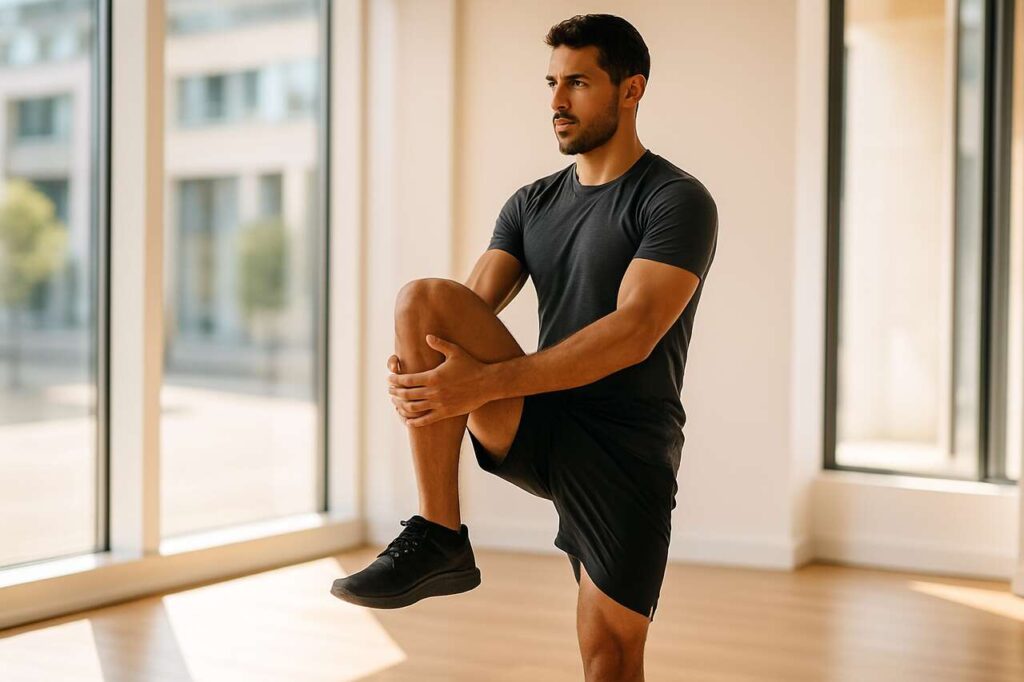
- Standing knee raises
The mechanics of upright core training
The fundamental difference between standing and supine core exercises lies in how gravity affects the body. When standing, the core must work to maintain spinal alignment against gravitational forces while simultaneously performing the prescribed movement. This dual demand creates a training environment that closely resembles how the core functions during daily activities like walking, lifting, or reaching.
The Pallof press exemplifies this principle by requiring practitioners to resist rotational pull from a resistance band or cable. The exercise begins with the band attached to an anchor point at chest height. Standing perpendicular to the anchor, the individual holds the band at chest level with both hands, then extends the arms forward while preventing the torso from rotating toward the anchor point. This anti-rotational component distinguishes it from many conventional core exercises.
Understanding these foundational concepts sets the stage for exploring how standing exercises activate core musculature differently than traditional approaches.
How standing exercises engage your core
Muscle activation patterns
Standing core exercises recruit muscles through integrated movement patterns rather than isolated contractions. The Pallof press specifically targets the obliques, transverse abdominis, and rectus abdominis while simultaneously engaging the shoulders, hips, and legs for stability. This multi-planar activation creates a training effect that extends beyond the superficial abdominal muscles.
The anti-rotational nature of the Pallof press forces the deep core stabilizers to work intensively. The transverse abdominis, often called the body’s natural weight belt, contracts to prevent unwanted rotation. Meanwhile, the obliques on both sides of the torso engage asymmetrically, with the side closer to the anchor working to resist the pull while the opposite side stabilizes the entire structure.
Functional strength development
Standing exercises develop functional strength by training movement patterns used in everyday life. When lifting a box from the floor or turning to place groceries on a shelf, the core must resist rotational forces while maintaining spinal stability. The Pallof press directly trains this capacity, making it particularly valuable for improving real-world performance.
| Movement Type | Primary Core Function | Daily Application |
|---|---|---|
| Anti-rotation | Resisting twisting forces | Carrying bags on one side |
| Anti-extension | Preventing excessive arching | Maintaining posture while standing |
| Anti-lateral flexion | Resisting side bending | Holding a child on one hip |
This functional approach to core training creates strength that transfers seamlessly to athletic performance and daily activities, offering advantages that extend well beyond aesthetic improvements.
The benefits of standing core exercises
Enhanced postural stability
Regular practice of standing core exercises significantly improves postural control and spinal alignment. By training the core to maintain stability in an upright position, these movements reinforce proper posture patterns that carry over into daily life. Improved posture reduces strain on the lower back and neck, potentially decreasing chronic pain associated with prolonged sitting or poor alignment.
Improved athletic performance
Athletes across various disciplines benefit from the rotational stability developed through standing core work. Runners experience better torso control, which enhances running economy and speed. Weightlifters develop the core strength necessary to safely handle heavier loads. The coordination required for standing exercises also improves overall body awareness and movement quality.
Accessibility and convenience
Standing core exercises offer practical advantages for individuals who find floor exercises uncomfortable or inaccessible. People with mobility limitations, pregnant women, or those recovering from certain injuries may find standing variations more appropriate. Additionally, these exercises require minimal equipment, with a simple resistance band providing sufficient resistance for effective training.
Key benefits include:
- Reduced stress on the neck and spine compared to floor exercises
- Greater muscle integration across the entire body
- Improved balance and coordination
- Enhanced functional movement capacity
- Versatility for different fitness levels
These advantages make standing core exercises particularly appealing for those seeking efficient, effective training methods that align with their specific needs and goals.
My experience: six months with the Pallof press
Initial challenges and adjustments
Beginning a Pallof press routine revealed immediate challenges that traditional exercises had not addressed. The anti-rotational component exposed weaknesses in core stability that sit-ups and planks had failed to target. During the first few weeks, maintaining proper form required intense concentration, and even light resistance created significant muscular fatigue.
The learning curve involved mastering several technical elements:
- Maintaining a neutral spine throughout the movement
- Preventing the hips from rotating toward the anchor point
- Controlling the tempo of both the extension and return phases
- Breathing consistently without holding breath during exertion
Progressive improvements observed
After approximately six weeks of consistent practice, noticeable improvements in core strength became apparent. Activities that previously caused lower back discomfort, such as carrying groceries or yard work, felt significantly easier. The ability to maintain proper posture during long periods of standing improved markedly.
By the three-month mark, the exercise that initially required full concentration became more intuitive. Resistance levels that once proved challenging now felt manageable, necessitating progression to heavier bands. The enhanced core stability translated to better performance in other exercises, particularly overhead presses and squats, where torso rigidity plays a crucial role.
Long-term transformation
Six months of dedicated Pallof press training produced comprehensive changes in core strength and overall physical capability. The transformation extended beyond mere strength gains to include improved body awareness and movement efficiency. Daily activities requiring twisting or reaching no longer created the same strain, and athletic pursuits benefited from enhanced rotational control.
The most significant realization came from understanding that core strength encompasses more than the ability to perform numerous repetitions of traditional exercises. The Pallof press developed a quality of strength that proved more applicable to real-world demands, creating stability that supported rather than isolated the core musculature.
These personal observations align with broader principles of effective core training, suggesting practical applications for others seeking similar improvements.
How to integrate standing exercises into your fitness routine
Programming considerations
Incorporating the Pallof press into an existing training program requires thoughtful planning. For optimal results, perform two to four sets of eight to fifteen repetitions per side, adjusting volume based on individual fitness levels and recovery capacity. The exercise works well as part of a comprehensive core training session or as a supplementary movement following primary strength work.
Frequency recommendations vary depending on training goals:
- Beginners: two to three sessions per week
- Intermediate practitioners: three to four sessions per week
- Advanced individuals: four to five sessions per week with varied resistance levels
Progression strategies
Progressive overload ensures continued adaptation and strength development. Begin with lighter resistance bands that allow proper form maintenance throughout all repetitions. As proficiency improves, advance through systematic progressions that increase difficulty without compromising technique.
| Progression Level | Modification | Difficulty Increase |
|---|---|---|
| Beginner | Light band, narrow stance | Baseline |
| Intermediate | Medium band, split stance | Moderate |
| Advanced | Heavy band, single-leg stance | Significant |
Complementary exercises
While the Pallof press provides excellent anti-rotational training, a comprehensive core program includes movements addressing different planes of motion. Combining standing exercises with complementary movements creates balanced development across all core functions.
Recommended pairings include:
- Dead bugs for anti-extension work
- Side planks for anti-lateral flexion
- Bird dogs for coordinated stability
- Farmer’s carries for loaded core endurance
This integrated approach ensures comprehensive core development while preventing overuse of specific movement patterns.
Standing core exercises, particularly the Pallof press, offer a practical and effective approach to developing functional strength that extends beyond traditional training methods. The anti-rotational nature of these movements addresses real-world demands while improving posture, athletic performance, and daily movement quality. Six months of consistent practice demonstrates that progressive training with proper technique yields substantial improvements in core stability and overall physical capability. By incorporating standing exercises into a balanced fitness routine with appropriate volume and progression, individuals can develop the comprehensive core strength necessary for optimal performance in both athletic pursuits and everyday activities.