


Balance becomes increasingly challenging as we age, yet it remains one of the most crucial skills for maintaining independence and quality of life. A seasoned yoga instructor with fifteen years of experience has observed a consistent pattern among her mature students: they frequently struggle with stability and equilibrium during standing poses. This common challenge stems from natural physiological changes that accompany aging, including muscle loss and bone fragility. Recognizing this widespread need, she has identified three fundamental standing poses that specifically address balance issues while building strength and confidence. These accessible exercises offer both physical and mental benefits, proving that age need not be a barrier to improved stability and bodily awareness.
Impact of age on balance among yoga students
Natural physiological changes affecting stability
The aging process brings significant changes to the body’s balance mechanisms. As students mature, they experience a natural decline in muscle mass, a condition known as sarcopenia, which directly impacts their ability to maintain equilibrium. Bone density decreases over time, leading to increased fragility and a heightened awareness of fall risks. These physiological transformations create a complex interplay of factors that challenge even experienced practitioners during their yoga sessions.
Common obstacles encountered in practice
Mature yoga students face several specific challenges that younger practitioners may not encounter:
- Joint instability resulting from wear and accumulated stress over decades
- Previous injuries that continue to affect mobility and confidence
- Reduced flexibility limiting range of motion in standing poses
- Decreased proprioception, the body’s ability to sense its position in space
- Mental hesitation stemming from fear of falling or injury
These obstacles compound one another, creating a cycle where lack of practice leads to diminished confidence, which in turn discourages further attempts at challenging balance poses. Understanding these interconnected factors helps instructors tailor their approach to meet the specific needs of older students while building their physical capabilities and self-assurance.
The importance of balance for an active life
Physical benefits extending beyond the yoga mat
Developing balance through yoga practice offers far-reaching advantages that extend into everyday activities. Standing poses strengthen multiple muscle groups simultaneously, including the legs, back, core, and hips. This comprehensive strengthening creates a foundation of stability that supports daily movements such as climbing stairs, reaching for objects, and navigating uneven surfaces. The improved muscle tone and coordination gained through regular practice translate directly into enhanced functional fitness.
Psychological and postural advantages
Beyond the physical realm, balance work provides significant mental benefits. Practitioners develop heightened awareness of their center of gravity, leading to improved posture throughout the day. This postural awareness reduces strain on the spine and joints, preventing chronic pain and discomfort. The psychological impact of mastering balance poses cannot be overstated, as students gain confidence in their bodies’ capabilities, reducing anxiety about movement and fostering a sense of empowerment in their daily lives.
| Benefit Category | Specific Improvements | Daily Life Impact |
|---|---|---|
| Muscular | Leg, core, and hip strength | Easier stair climbing, standing |
| Postural | Spinal alignment, gravity awareness | Reduced back pain, better sitting |
| Mental | Focus, body confidence | Reduced fall anxiety, independence |
These multifaceted benefits demonstrate why balance training serves as a cornerstone of healthy aging, addressing both the physical realities and emotional needs of mature practitioners.
Understanding the balance challenges of mature students
The mind-body connection in stability
Balance transcends mere physical ability, representing a profound integration of mental and bodily awareness. As one experienced instructor articulates, when the mind is scattered, the body wavers, but when attention is fixed, the body follows. This observation highlights the critical role of mental focus in maintaining equilibrium. Mature students often carry mental distractions, worries about injury, or memories of past falls that interfere with their ability to center themselves during practice.
Specific factors impairing equilibrium
Several interconnected elements contribute to balance difficulties among older yoga students. Joint instability creates uncertainty in weight-bearing positions, making practitioners hesitant to fully commit to standing poses. Previous injuries, even those from years past, leave lasting impacts on movement patterns and confidence. Mobility challenges restrict the range of compensatory movements available when balance is threatened, creating a narrower margin for error.
The lack of consistent practice compounds these physical limitations. When students avoid challenging balance poses due to fear or difficulty, they miss opportunities to strengthen the very systems that would improve their stability. This creates a self-perpetuating cycle where avoidance leads to deterioration, which reinforces the initial reluctance. Breaking this pattern requires understanding that balance is a skill that can be developed at any age with appropriate guidance and regular practice, setting the stage for exploring specific poses that address these challenges effectively.
Tree pose: a cornerstone of stability
Fundamental mechanics and muscle engagement
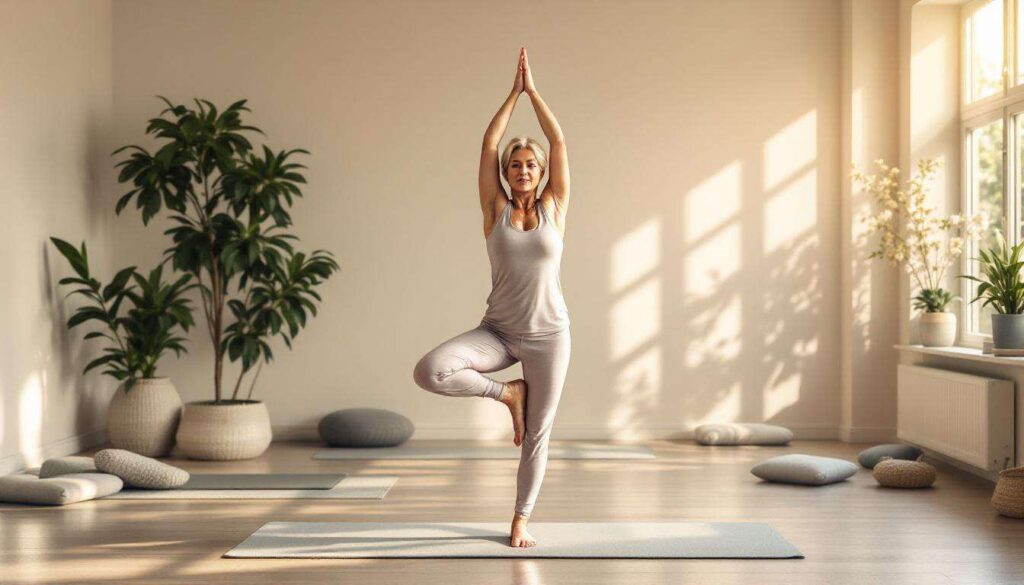
Tree pose stands as one of the most accessible yet effective balance exercises for mature students. This foundational posture requires practitioners to stand on one leg while placing the opposite foot against the standing leg, either at the ankle, calf, or inner thigh. The pose engages the muscles throughout the standing leg, from the foot’s intrinsic muscles through the calf, quadriceps, and hamstrings. Simultaneously, the core muscles activate to maintain an upright torso, creating a full-body integration that builds strength and coordination.
Modifications and progression strategies
The beauty of tree pose lies in its adaptability to various skill levels and physical limitations:
- Beginners can practice with the raised foot resting on the ankle while toes remain on the floor
- Using a wall or chair for light fingertip support builds confidence
- Gradually increasing hold time from a few breaths to a minute or more
- Advanced practitioners can close their eyes to challenge proprioception
- Adding arm variations overhead intensifies the balance requirement
These progressive modifications allow students to work at their current level while providing clear pathways for advancement. The pose develops not only physical strength but also mental concentration, as maintaining balance requires sustained focus and present-moment awareness, preparing practitioners for more dynamic balance challenges.
Warrior III pose: strength and balance
Full-body integration and stabilization
Warrior III represents a more advanced balance challenge that offers exceptional strengthening benefits for the entire body. In this pose, practitioners balance on one leg while extending the other leg behind them parallel to the floor, simultaneously reaching the arms forward to create a horizontal line from fingertips to back toes. This position demands intense engagement from multiple muscle groups, including the standing leg, glutes, back muscles, and core stabilizers. The pose builds functional strength that directly translates to improved stability in daily activities.
Approaching the pose safely
For mature students, warrior III requires careful progression and appropriate modifications. Beginning with hands on a wall or chair allows practitioners to focus on the leg extension and hip alignment without the full balance challenge. The lifted leg need not reach parallel to the floor initially; even a modest lift provides significant benefits. Core engagement proves crucial for protecting the lower back while maintaining the pose, requiring students to draw the navel toward the spine and keep the hips level.
| Muscle Group | Primary Action | Stability Benefit |
|---|---|---|
| Standing leg | Weight bearing, balance | Ankle and knee strength |
| Glutes | Hip extension, leg lift | Pelvic stability |
| Core | Torso stabilization | Spinal protection |
| Back muscles | Horizontal alignment | Posture improvement |
Regular practice of warrior III builds the strength and confidence necessary for the final recommended pose, which adds a lateral dimension to balance training.
Half moon pose: reducing the risk of falls
Lateral stability and fall prevention
Half moon pose addresses a critical aspect of balance often neglected in standard training: lateral stability. This pose requires balancing on one leg while the body tilts sideways, with the opposite leg extended parallel to the floor and one hand reaching toward the ground for support. The sideways orientation challenges the body in a plane of movement frequently involved in falls, making this pose particularly valuable for mature students concerned about injury prevention.
Building confidence through supported practice
The pose can be practiced with the supporting hand on a block, chair, or wall, allowing students to focus on alignment and muscle engagement before attempting the full expression. Key elements include:
- Stacking the hips vertically to engage the oblique muscles
- Pressing firmly through the standing foot to activate the leg muscles
- Extending through the raised leg to create length and stability
- Opening the chest toward the ceiling to improve balance
- Focusing the gaze upward or forward depending on neck comfort
This pose develops proprioceptive awareness in multiple planes, training the body to respond quickly to shifts in equilibrium. The strength gained in the lateral stabilizing muscles proves invaluable for preventing falls during everyday activities that involve sideways movements or uneven surfaces, making it an essential component of a comprehensive balance training program.
Incorporating these poses into a daily yoga routine
Creating a sustainable practice schedule
Consistency proves more valuable than intensity when developing balance skills. Mature students benefit from practicing these three poses daily, even if only for a few minutes. A simple routine might include holding each pose for three to five breaths on each side, gradually increasing duration as strength and confidence improve. The accessibility of these exercises allows them to be practiced at various times throughout the day, not requiring a full yoga session or special equipment.
Practical integration strategies
Students with mobility limitations can adapt their practice to fit their circumstances:
- Practice tree pose while brushing teeth or waiting for coffee to brew
- Use warrior III at a kitchen counter during meal preparation
- Incorporate half moon pose during television commercial breaks
- Begin each morning with a brief balance sequence before other activities
- End the day with gentle balance work to promote body awareness before sleep
These integration strategies remove common barriers to practice, such as time constraints or lack of motivation for formal exercise sessions. By weaving balance work into existing daily routines, students develop the consistency necessary for meaningful improvement. The cumulative effect of regular practice strengthens muscles, improves core engagement, and builds the neural pathways that support automatic balance responses in challenging situations.
Balance training through yoga offers mature students a powerful tool for maintaining independence and confidence as they age. The three recommended standing poses address balance challenges from multiple angles, building strength in the legs, core, and stabilizing muscles while developing mental focus and body awareness. Tree pose establishes fundamental single-leg stability, warrior III adds dynamic full-body integration, and half moon pose develops crucial lateral balance skills. Together, these accessible exercises provide comprehensive benefits that extend far beyond the yoga mat, reducing fall risk and enhancing quality of life. Through consistent practice and appropriate modifications, students of any age or ability level can experience improved coordination, increased strength, and the psychological benefits of mastering their bodies’ capabilities in space.