



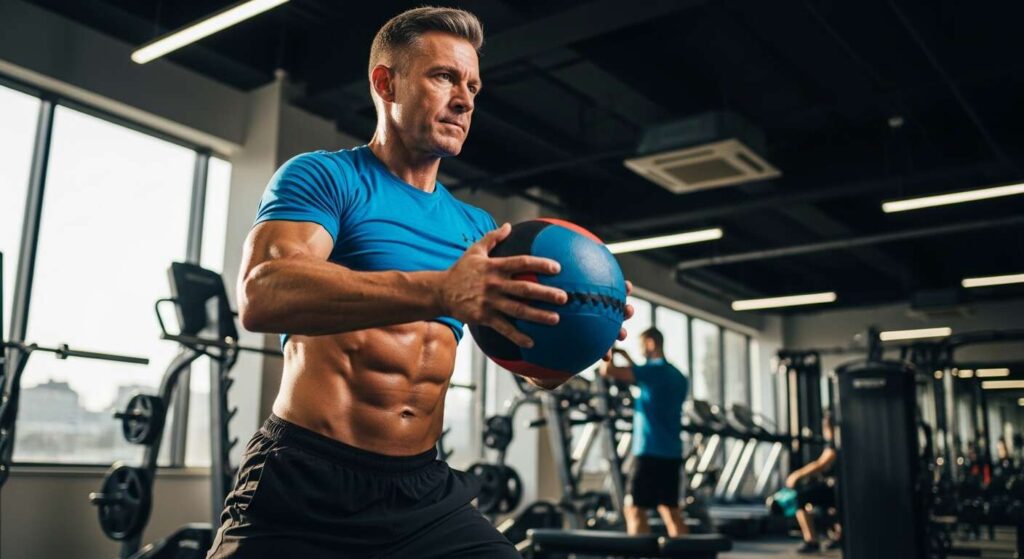
Building a strong core requires more than endless sit-ups and basic planks. After nearly two decades of training clients, one personal trainer has identified a 10-minute abs finisher circuit that stands out for its ability to develop comprehensive core strength from every angle. This efficient routine requires no equipment, making it accessible for anyone looking to strengthen their midsection effectively. The circuit focuses on engaging the entire core musculature through varied movements that challenge stability, rotation, and anti-extension capabilities.
The importance of the finisher in a workout
Why finishers matter for training effectiveness
A workout finisher serves as the crucial final component of a training session, designed to maximize muscle engagement and metabolic demand. Unlike traditional cooldowns, finishers push the body through high-intensity movements that target specific muscle groups with precision. For core training, finishers prove particularly valuable because they fatigue the abdominal muscles after the primary workout, ensuring complete muscular exhaustion and optimal growth stimulus.
Three essential elements of an effective abs finisher
According to experienced trainers, a quality abs finisher must incorporate three fundamental characteristics:
- Variety of movements: engaging different muscle fibers through diverse exercise patterns
- Effectiveness and challenge: providing sufficient intensity to stimulate adaptation without compromising form
- Multi-angle engagement: working the core from various directions rather than focusing solely on frontal plane movements
These elements ensure that the entire core musculature receives adequate stimulation, including the rectus abdominis, obliques, transverse abdominis, and deeper stabilizing muscles. The combination creates a comprehensive approach that builds functional strength applicable to daily activities and athletic performance.
Time efficiency and metabolic benefits
A well-designed 10-minute finisher delivers maximum results in minimal time. This efficiency makes it ideal for busy individuals who need effective training solutions without extended gym sessions. The metabolic demand created by consecutive exercises elevates heart rate, promoting cardiovascular benefits alongside muscular development. This dual benefit transforms a simple abs routine into a comprehensive fitness tool that addresses multiple training objectives simultaneously.
Understanding these principles provides the foundation for appreciating the specific exercises that compose this highly effective circuit.
Introducing the exercises of the 10-minute abs finisher
The four-exercise circuit structure
This equipment-free circuit consists of four carefully selected exercises that work synergistically to develop complete core strength. Each movement targets specific functions:
- Reverse crunch: focuses on lower abdominal engagement and hip flexion control
- Hollow plank: develops anti-extension strength and full-body tension
- Plank side-to-side feet jump: challenges lateral stability and dynamic control
- Bicycle crunches: incorporates rotation and coordination
Execution protocol for optimal results
The circuit follows a minimal rest protocol that maintains muscular tension throughout the session. Practitioners perform all four exercises consecutively, then repeat the entire sequence. Two approaches work effectively:
| Method | Structure | Best For |
|---|---|---|
| Fixed rounds | Complete 3 total rounds | Beginners and structured programming |
| AMRAP | As many rounds as possible in 10 minutes | Advanced practitioners seeking maximum intensity |
Progressive adaptation strategies
For those new to high-intensity core work, a graduated approach prevents excessive fatigue and maintains proper form. Starting with 30 seconds of work followed by 30 seconds of rest allows the body to adapt gradually. As strength increases, practitioners can reduce rest intervals to 20 seconds, then 15 seconds, ultimately performing exercises consecutively without pause. This progressive overload ensures continuous improvement while minimizing injury risk.
With the overall structure established, examining each exercise’s proper execution becomes essential for maximizing effectiveness.
How to perform an effective hollow plank
Establishing the hollow body position
The hollow plank represents a fundamental anti-extension exercise that builds tremendous core stability. Begin by lying face down, then press into a standard plank position with forearms on the floor and elbows directly beneath shoulders. The key distinction lies in creating a posterior pelvic tilt by tucking the tailbone under and drawing the belly button toward the spine. This position eliminates the natural lumbar curve, creating the characteristic “hollow” shape that maximizes abdominal engagement.
Common mistakes to avoid
Several technical errors compromise the effectiveness of this movement:
- Sagging hips: allowing the pelvis to drop creates excessive lumbar extension and shifts tension away from the core
- Elevated hips: raising the hips too high reduces abdominal engagement and transforms the exercise into a shoulder hold
- Holding breath: breath-holding increases blood pressure and reduces endurance capacity
- Relaxed shoulders: failing to actively push the floor away decreases scapular stability
Breathing and duration guidelines
Maintaining controlled breathing throughout the hollow plank proves essential for sustained performance. Inhale through the nose for three counts, then exhale through the mouth for three counts, maintaining constant core tension. For the 10-minute circuit, holding the position for 30 to 45 seconds provides sufficient stimulus without excessive fatigue. Advanced practitioners can extend duration to 60 seconds while maintaining perfect form.
Building on this foundational stability exercise, the circuit incorporates dynamic movements that challenge core control through motion.
The benefits of the plank side-to-side feet jump
Dynamic stability and power development
The plank side-to-side feet jump transforms static core stability into dynamic control by adding explosive lateral movement. From a high plank position with hands beneath shoulders, practitioners jump both feet simultaneously to the right side, landing outside the right hand, then immediately jump to the left side. This plyometric variation develops several critical attributes simultaneously: lateral stability, hip mobility, cardiovascular endurance, and reactive core strength.
Muscle activation patterns
This exercise engages multiple muscle groups through coordinated action:
| Muscle Group | Function | Training Benefit |
|---|---|---|
| Obliques | Resist rotation during landing | Enhanced lateral stability |
| Hip flexors | Drive knee lift during jump | Improved hip mobility |
| Transverse abdominis | Maintain spinal stability | Better force transfer |
| Shoulders | Support body weight | Increased upper body endurance |
Progression and regression options
For those finding the full movement too challenging, stepping feet side to side rather than jumping provides a lower-impact alternative that maintains the lateral stability component. Conversely, advanced practitioners can increase difficulty by adding a push-up between each jump or increasing tempo. The versatility of this exercise makes it suitable for various fitness levels while maintaining its core-strengthening benefits.
Complementing these dynamic movements, the circuit includes rotational exercises that target the obliques and improve functional movement patterns.
Optimize bicycle crunches for maximum results
Proper execution technique
The bicycle crunch stands as one of the most effective exercises for targeting the rectus abdominis and obliques simultaneously. Lie on your back with hands gently supporting the head, elbows wide, and legs extended at a 45-degree angle. Bring the right knee toward the chest while simultaneously rotating the torso to bring the left elbow toward the right knee. The key lies in controlled rotation rather than speed, ensuring the obliques perform the work rather than momentum.
Maximizing muscle engagement
Several technical refinements significantly enhance the effectiveness of bicycle crunches:
- Maintain constant tension: keep shoulders lifted off the floor throughout the entire set
- Extend fully: straighten the non-working leg completely to increase rectus abdominis engagement
- Rotate from the core: initiate movement from the obliques rather than pulling with arms
- Control the tempo: perform each repetition deliberately, taking two seconds per side
- Breathe rhythmically: exhale during the crunch, inhale during the extension
Repetition ranges and intensity modulation
For the 10-minute circuit, performing 15 to 20 total repetitions (counting each side as one rep) provides optimal stimulus. Beginners may reduce to 10 to 12 reps while maintaining perfect form, while advanced practitioners can increase to 25 to 30 reps or slow the tempo to increase time under tension. The focus should remain on quality of movement rather than quantity, as proper execution delivers superior results compared to rushed repetitions with compromised technique.
The final exercise in this comprehensive circuit adds another dimension of core challenge through multi-directional movement.
Integrating the rolling plank for 360˚ core strength
Understanding the rolling plank movement
The rolling plank represents the culmination of the circuit, combining elements of stability, rotation, and anti-extension into one comprehensive movement. Begin in a forearm plank position, then rotate onto the right forearm into a side plank, hold briefly, return to center, then rotate to the left side. This continuous rolling motion challenges the core to stabilize through multiple planes of movement, developing the 360-degree strength that defines functional core fitness.
Technical execution points
Achieving maximum benefit from rolling planks requires attention to specific technical details:
- Stack joints properly: in side plank position, align shoulder, hip, knee, and ankle vertically
- Maintain hip height: prevent hips from sagging during transitions between positions
- Control rotation speed: move deliberately rather than using momentum
- Engage obliques actively: feel the side muscles working to maintain position
- Keep core braced: maintain constant tension throughout the entire movement sequence
Building comprehensive core strength
The rolling plank develops functional strength that translates directly to athletic performance and daily activities. By challenging the core through frontal, sagittal, and transverse planes simultaneously, this exercise builds:
| Strength Component | Movement Phase | Real-World Application |
|---|---|---|
| Anti-extension | Front plank position | Lifting heavy objects |
| Lateral stability | Side plank hold | Change of direction in sports |
| Rotational control | Transition between sides | Throwing and swinging movements |
For the circuit, performing 6 to 8 complete rolling sequences (center to right to center to left equals one sequence) provides sufficient volume. This exercise serves as the perfect finisher within the finisher, ensuring complete core fatigue and maximum training stimulus.
This 10-minute abs finisher circuit delivers comprehensive core development through strategic exercise selection and intelligent programming. By incorporating movements that address anti-extension, lateral stability, rotation, and dynamic control, the routine builds functional strength that extends beyond aesthetic benefits. The equipment-free nature and time efficiency make it accessible for practitioners at any fitness level, while the progressive adaptation options ensure continued challenge as strength improves. Implementing this circuit consistently, combined with proper nutrition for revealing developed musculature, provides a complete approach to building a strong, resilient core that supports both athletic performance and everyday movement quality.